Thank God For Data Centers

TL;DR · AI Summary
数据中心为AI提供了巨大的资金支持,推动了新技术的发展,甚至可能促进再工业化。
Key Takeaways
- 数据中心为AI提供了大量资金支持。
- AI数据中心可能促进再工业化。
- 数据中心通过需求推动新技术成本下降。
Outline
Jump quickly between sections.
Mindmap
See how the topics connect at a glance.
查看大纲文本(无障碍 / 无 JS 友好)
- 数据中心的重要性
Highlights
Key sentences worth saving and sharing.
数据中心为AI提供了巨大的资金支持,推动了新技术的发展。
AI数据中心可能成为再工业化的重要推动力。
历史上,Alpha产品和额外经济买家通过需求推动了技术成本下降。
Thank God For Data Centers
_Welcome to the 2,232 newly Not Boring people who have joined us since our last essay! Join267,788 smart, curious folks by subscribing here:_
Hi friends 👋,
Happy Wednesday!
A couple of weeks ago, I asked if you wanted me to start sharing more off-the-cuff notes with Not Boring World subscribers, and the response was great, so we’re back. It’s a Wednesday afternoon, not my normal send time, but these are meant to be less formal and more, “I noticed something interesting, here are my quick thoughts.” This one happens to be a little longer than it is quick, but it’s one I wanted to get out for two reasons:
- People hate AI data centers, and I think they’re wrong, even if they don’t like AI.
- Because I keep hearing, reading, and seeing that AI data centers are funding new technologies before they’ve come down the learning curve, which might be a providentially big boon to reindustrialization and all of the hard, physical things we want to see in the world.
It’s pretty beautiful that gaming chips that evolved from Apollo-funded integrated circuits are creating a product with so much demand that their facilities can pay for all sorts of novel technologies, just like the Apollo Program did.
Let’s get to it.
_Hiring globally doesn’t have to be complicated_
_Hiring globally can unlock growth, but local laws, payroll, and compliance often slow startups down._
_Deel’s free guide breaks down what an Employer of Record (EOR) is, how startups use EORs to hire internationally without opening entities, and when it makes sense to use one so you can scale with confidence._
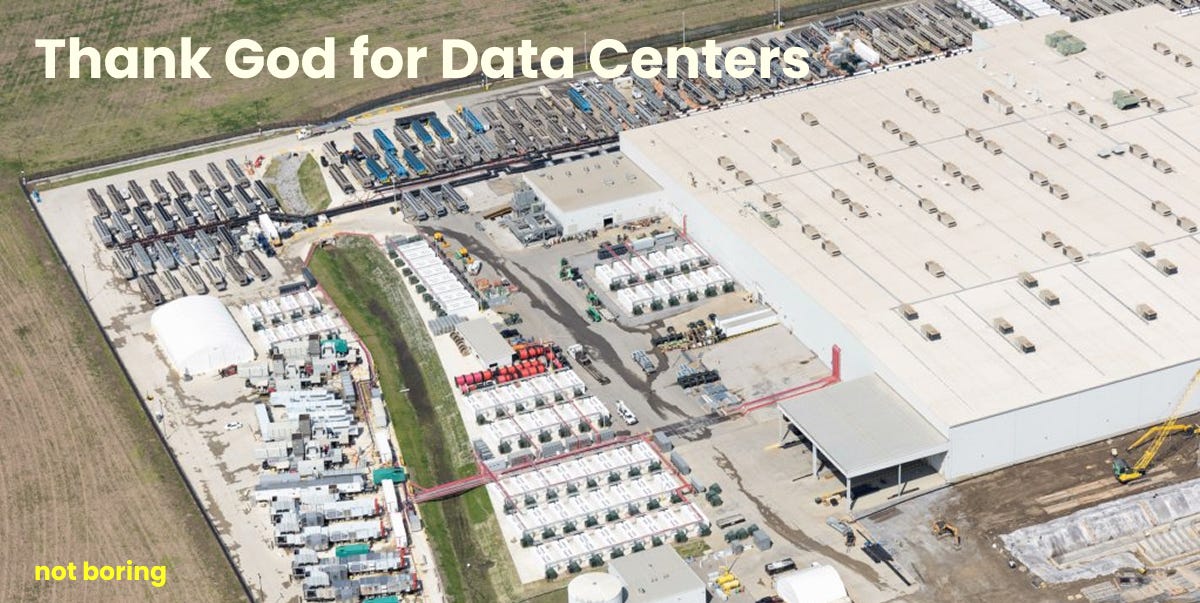
There exists a vast pool of technologies that are potentially superior to those we employ today, but which require scale and learning curves to reach their potential.
Advanced nuclear reactors are one such technology—they are more expensive than alternatives today, but manufactured at scale and benefiting from the learning curves required to get there, may become cheaper than other generation technologies. The cost physics are on their side, and nuclear is reliable, safe, firm, and clean.
The challenge with these technologies, in normal times, is that there is little economic incentive for the buyers who would enable the scale to take the risk. Natural gas is cheap and abundant, and it’s not _that_ bad for the environment, compared to coal and oil at least, and the environment is someone else’s problem, anyway. And so, in normal times, we remain stuck in local maxima without the demand to push towards global ones.
Historically, these stalemates have cracked in a couple of main ways: Alpha Products and extraeconomic Buyers of Capabilities. These are essentially the same mechanism at different scales and with different motivations.
In _The Electric Slide,_ we discussed the role that Alpha Products played in providing the initial demand that eventually brought each layer of the Electric Stack down their respective cost-performance curves. For lithium-ion batteries, the alpha product was the Sony Handycam. For neodymium magnets and motors, it was the 3.5” hard-disk drive. For power electronics (IGBTs / inverters), it was the variable-frequency drive (VFD) for industrial motors. For microcontrollers (MCUs), it was the calculator. Etc.
For each of these, the new technology was advantageous enough in a specific way to the end product that it was worth paying higher costs or sacrificing on other capabilities to capture those benefits.
Alpha Products, however, typically support components that are not multi-hundred million or multi-billion dollar projects in their own right.
The role of the extraeconomic Buyer of Capabilities in the development of new technologies is even better understood. This is the DoD or NASA, mainly, buying technologies to confer a specific advantage, almost irrespective of their cost. This category of customer cares less about price than about capability.
Their role is important because it gives new technologies the opportunity to get to scale, come down the learning curve, and ultimately compete in the much larger commercial market.
For a while now, but particularly over the past couple of weeks, I’ve heard variations of the same story repeatedly:
“We are still pursuing our long-term mission, but to fund it, we’re planning to sell to data centers.”
Today, data centers are increasingly acting as buyers of capabilities, functioning somewhere between a government and a commercial buyer. The data center is the meta-Alpha product. If you can sell them what they need quickly, they have an almost unlimited budget.
This applies to obvious things like GPUs, inference chips, and DRAM, but it also extends to companies that aren’t typically associated with AI data centers, such as supersonic turbines, enhanced geothermal systems, modular construction, high-voltage direct current grids, solid-state transformers, silicon photonics, optical fiber, lasers, batteries, and nuclear technology.
Many of these technologies have the _potential_ to be better and cheaper than the incumbent technologies they aim to replace, but they have been too expensive and unproven to compete. With backlogs in all traditional inputs to data centers, however, developers are willing to pay more for new technologies that can deliver quickly, giving them the opportunity to scale up and reduce costs.
For these technologies, data centers act as a third type of buyer of capabilities, a commercial analog operating on DoD-style procurement logic but with commercial timelines.
Given the size of the budgets, the relatively small cost of any single input compared to the overall project cost and revenue opportunity, and the speed at which data centers are making decisions and placing deposits, data centers may significantly increase the chances of success for hard tech companies and [vertical integrators](https://www.notboring.co/p/vertical-integrators) more than the market realizes.
Far from being the villains they are portrayed as (often through misinformation and largely due to their association with deeply unpopular AI), data centers may be the greatest accelerator of American reindustrialization and a built-world future that benefits everyone we’ve ever seen.
They provide non-dilutive capital (real revenue on a negative working capital cycle) to fund big visions, and more importantly, the opportunity to scale up and learn faster than would otherwise be possible. This both accelerates the timelines of things that might have worked but more slowly and makes companies that might otherwise have failed in the Valley of Death viable.
Whatever your feelings are on AI, the criticism directed at data centers is misplaced. Hell, whether or not you think we’re in an AI bubble barely matters here. In five years, this could all fall apart, and the world will be much better off. Data centers are funding the future where no one else will.
This isn’t the first time people have gotten angry that something frivolous is consuming so many resources. The immediate concerns—like how much money is being spent or power is being consumed—are easy targets, while the long-term benefits are hard to see.
With hindsight and distance, the Apollo mission has become one of America’s proudest accomplishments. At the time, however, not everyone supported JFK’s decision to go to the Moon. There were too many problems on Earth to waste all that time, money, and talent on a lunar boondoggle.
In May 1961, Gallup asked Americans, “It has been estimated that it would cost the United States 40 billion dollars—or an average of about $225 per person—to send a man to the moon. Would you like to see this amount spent for this purpose, or not?” 58% of respondents said no, another 9% had no opinion, and only 33% supported the mission.
President John F. Kennedy gave his famous “We choose to go to the Moon” speech not because it was popular, but because it was unpopular and he needed to rally support.
It didn’t work well. In a 1964 Gallup poll asking “Do you think the United States should go all out to beat the Russians in a manned-flight to the moon—or don’t you think this is too important?”, 66% of respondents said it wasn’t too important, and another 8% said “Don’t know,” which amounted to the same thing. In the summer of 1965, “one-third of the nation favored cutting the space budget, while only 16% wanted to increase it.”
Even a decade after NASA achieved the near-impossible, in 1979, only 41% of Americans told an NBC/AP poll that the benefits of the space program outweighed the costs. By 1995, that had risen to 47%, by 1999 it hit 55%, and by the 50th anniversary of the Moon Landing, in 2019, support had reached 64%.
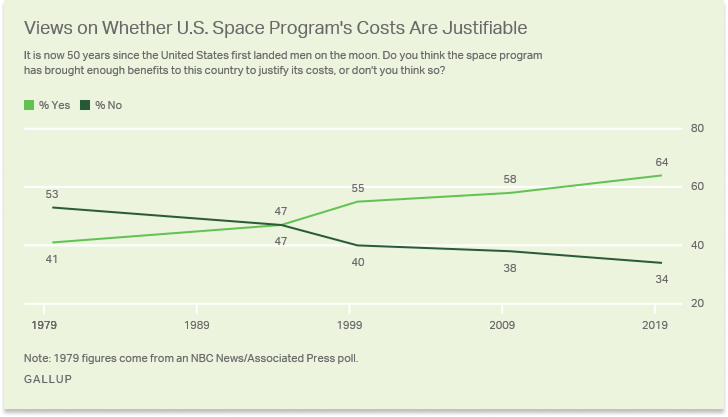
One explanation is that, not having to pay the costs ourselves but getting to bask in the memory of victory, today’s Americans can look back and say it was worth it.
Another explanation is that over time, the real benefits, not at all obvious at the time, have become clearer.
Critics of Apollo were ultimately proven wrong, not only because beating the Soviets to the Moon was an incredible achievement...
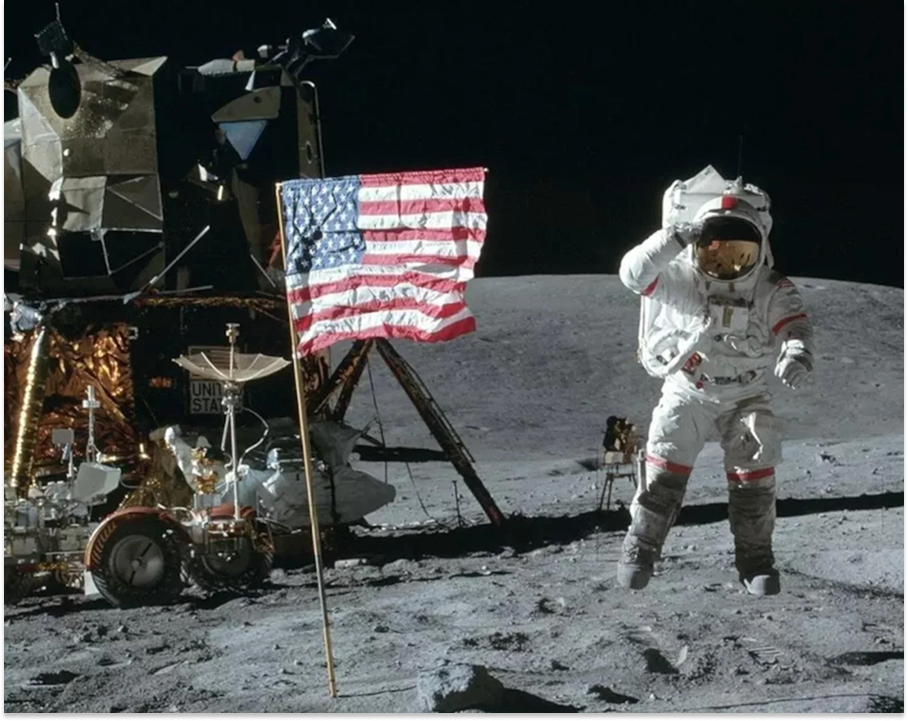
... but also because the audacity of the task combined with its enormous budget, which critics complained about, were precisely the conditions needed to create earth-bound innovations that would otherwise have taken much longer or might never have been invented at all.
While the role of the Apollo Program in _inventing_ new technologies may be overstated, it accelerated, scaled, and reduced the risks associated with many developments that might not have reached a sufficient scale or cost to impact our lives. Some of the technologies and products that benefited from this include:
- Fireproof fabrics and flame-retardant materials (developed after the Apollo 1 fire), which found their way into firefighter suits and racing gear
- Improved freeze-drying processes for food preservation
- Mylar-based reflective insulation, which became the emergency space blanket
- Advances in composite materials and ablative coatings
- CAT and MRI imaging benefited from digital image processing techniques developed to enhance lunar photographs at JPL
- Implantable cardiac pacemakers improved from bidirectional telemetry developed for astronaut biosensors
- Cool suits (liquid-cooled garments) used for MS patients, burn victims, and racing drivers came directly from the spacesuit undergarment
- Kidney dialysis machines used a chemical process developed to remove toxins from astronauts’ water
- Black & Decker developed the technology for cordless power tools for collecting lunar samples
- NASA developed Memory foam (Tempur-Pedic) for crash protection in seats
- Water filtration using silver ions, based on the system that purified the Apollo crew’s water
- Scratch-resistant lens coatings, derived from coatings developed for astronaut visors
- Improved smoke detectors (the modern ionization-type was refined for Skylab, which leveraged Apollo hardware)
Even cleanroom protocols for handling lunar samples spread into pharmaceuticals and, relevant to today’s discussion, semiconductor manufacturing.
That’s just one program, albeit a very large one. If you zoom out to include the technologies that received early support from the DoD, the list includes pretty much everything that defines modern life.
The internet and TCP/IP directly, and Ethernet indirectly. Satellite communications, GPS, the inertial navigation systems in our phones and cars, and radio navigation. The mouse, windowing interfaces, and hypertext; the work that Doug Engelbart showcased in his “Mother of All Demos” was ARPA-funded. Public-key cryptography was invented for UK SigInt, Grace Hopper developed COBOL on the Navy’s dime, and DARPA funded the first AI labs at MIT, Stanford, CMU, and SRI for decades. The chips AI runs on, GPUs, and the CUDA software behind them, owe something to DARPA-funded parallel computing research. Siri’s lineage, for better or worse, traces back to DARPA’s CALO speech recognition program at SRI. There are the more obviously military products, like jet engines and the planes they power, stealth coatings, night vision, radar and synthetic aperture radar, Lidar, ultrasound, drones, and infrared and thermal imaging. There are materials, like composites, including carbon fiber, titanium alloys, and advanced ceramics, all of which scaled through defense procurement. LEDs were funded through early signaling work, and digital photography found a buyer in early spy planes. In medicine, we have the DoD to thank for EpiPens, tourniquets, hemostatic agents like QuikClot, prosthetics, blood banking, and plasma storage. Penicillin was first mass-produced in a wartime crash program. And energy? Civilian nuclear power descended directly from Admiral Rickover’s Naval reactor program, lithium-ion battery research had defense funding, and solar photovoltaic cells were driven forward by the unique power needs of satellites.
Military procurement is the closest thing the United States has to a national industrial policy, and it has worked. The military has funded the development of virtually every general-purpose technology of the past century, before the commercial market took those de-risked, cost-reduced technologies and figured out how to bring them to the masses.
Of all these, the cleanest case study and the one that maps most directly onto what’s happening in 2026, is the integrated circuit.
Fairchild Semiconductor was founded in 1957 as a transistor company, and its first major customer was the military.
Specifically, facing a threat from larger Soviet boosters capable of launching intercontinental ballistic missiles (ICBMs) that could fit vacuum tubes, the US military, with its smaller boosters, had to invest in miniaturization, which meant transistors. Between 1958 and 1960, Fairchild’s revenue grew from $500k to $21 million, largely due to the Minuteman I program, for which it produced custom designs. The challenge was that as the number of transistors increased, the electronics industry encountered the “tyranny of numbers”: now that they could, engineers wanted to design circuits with thousands of components, all of which had to be wired together by hand.
So in Dallas, Texas Instruments’ Jack Kilby came up with his “monolithic idea.” “He realized that,” Carl Leonard writes, “instead of connecting separate components, an entire electronic assembly could be made as one unit from one semiconducting material by overlaying it with various impurities to replicate individual electronic components, such as resistors, capacitors, and transistors.” He had invented the integrated circuit (IC).
Three months later, in Mountain View, Fairchild co-founder Bob Noyce arrived at a similar idea from a different angle. Starting from the planar process, invented by Jean Hoerni in early 1959, Noyce realized that you could build transistors flat on a silicon wafer, with all the connections on the top surface, protected by a layer of silicon oxide. He wrote in his notebook, “In many applications now it would be desirable to make multiple devices on a single piece of silicon in order to be able to make interconnections between devices as part of the manufacturing process, and thus reduce size, weight, etc., as well as cost per active element,” and filed a patent that year.
While there are differences between the ICs they developed (Kilby’s used Geranium and Noyce’s silicon, for example), the two are credited as the co-inventor of the IC. What matters for our story is 1) the IC may not have been developed without demand from the Air Force, Army, and Navy, which were each spending real money on parallel attempts to solve it, and 2) Fairchild was now in the IC business.
In 1961, after starting at $1,000 per chip on tiny pilot runs the year before, Fairchild brought the integrated circuit to market at $120 per chip. The challenge was, no one really needed an integrated circuit, not enough to pay that price. Any electronics firm could wire together discrete transistors to do the same thing for a fraction of the price. As Britannica puts it, “a buyer had to have a serious space constraint to justify purchasing ICs.” Fortunately for Fairchild, NASA had a serious space constraint.
In early 1962, MIT’s Instrumentation Lab, which was responsible for the Apollo Guidance Computer (AGC), placed a test order for 100 ICs at $43.50 per unit. Meanwhile, getting ahead of volume and hoping to use scale to rev aerospace demand, Noyce cut the price of the IC from $120 to $15, an 87.5% drop, while still charging NASA and MIT premium prices to fund scale. “Noyce slashed prices, too, gambling that this would drastically expand the civilian market for chips,” Chris Miller wrote in _Chip War_. “In the mid-1960s, Fairchild chips that previously sold for $20 were cut to $2. At times Fairchild even sold products below manufacturing cost, hoping to convince more customers to try them.”
Meanwhile, the government funded the gap. That November, MIT decided to go with Fairchild’s IC, or more specifically, its Micrologic computer made up of ICs. By 1963, MIT was consuming 60% of US IC production for the AGC; other military and aerospace buyers made up the rest. In a 1964 article for IEEE, Noyce wrote, “Military and space applications accounted for essentially the entire integrated circuits market last year, and will use over 95 per cent of the integrated circuits produced this year.”
In 1965, the year that Gordon Moore wrote the _Cramming More Components onto Integrated Circuits_ paper that birthed Moore’s Law, ICs had reached cost parity with discrete components, at around $10, and were beginning to beat them. It was around this time that the Minuteman II program, which now used Texas Instruments ICs, became the technology’s largest buyer. That meant two things – 1) there were multiple large buyers of ICs and 2) there was competition – which combined caused Noyce to cut prices again, down to $2, and again, to $1. The cash coming in from Apollo allowed him to attack the commercial market with lower prices.
And it worked. By the end of the decade, America beat the Russians to the Moon, and Burroughs released the B2500 computer, the first to use ICs.
From that point forward, Moore’s Law has largely been driven by demand from the much larger and faster-moving commercial market. But the IC would not have come down the cost curve so quickly – and Moore’s Law, that self-fulfilling prophecy, may never have been coined or executed against – without the early space and military demand. It is to these Buyers of Capabilities that we owe the computer-powered world we inhabit today.
Something similar might be happening with Data Centers today.
There is a sentiment floating around that we can’t build hard things in America anymore, but by any measure, modern AI data centers are hard assets to build and operate, and we are building a lot of very big ones. Western hyperscalers, labs, and neoclouds will spend something like $750 billion this year and more than $1 trillion next year building them. Goldman estimates that AI CapEx will take $7.6 trillion of capital between 2026 and 2031 across Compute, “Data Centers,” and Power.
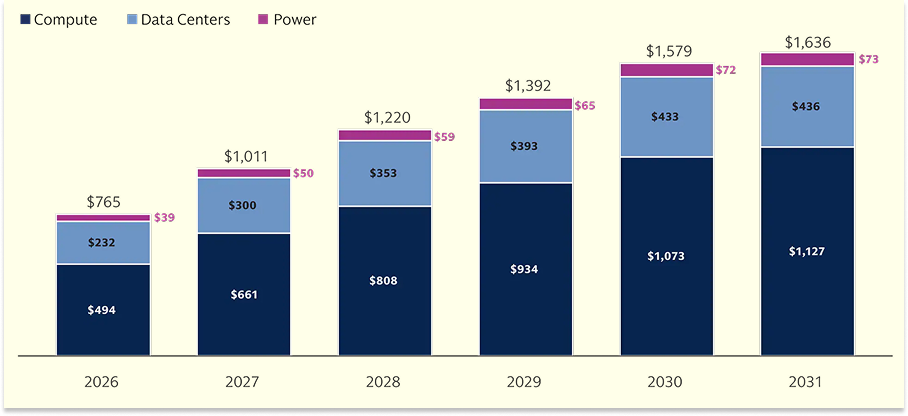
_Goldman Sachs_
This is a massive amount of CapEx, historically speaking, regardless of how you look at it. With US GDP around $32 trillion, this year’s spending represents 2.4% of GDP. Assuming GDP grows by a robust 3% next year, AI CapEx will account for 3.1% of GDP. For context, the Manhattan Project reached 0.4% of GDP, the late-90s telecom bubble peaked at 1.2%, and even the Apollo Program only reached 0.4%. To find a project that dominates GDP more significantly, you would need to look at one of the two World Wars, the New Deal, or the Railroad Boom.
For additional context, the $15 billion per year that Anthropic will pay SpaceX for the use of two of its Colossus data centers is roughly 60% of NASA’s entire annual budget.