From systems of record -> systems of intelligence

TL;DR · AI 摘要
从记录系统到智能系统的转变,AI通过整合多源数据提供更高价值的决策支持。
核心要点
- 记录系统如同孤立的文件柜,而智能系统则像跨文件柜的大脑。
- 智能系统能回答更复杂的问题,如预测交易延迟及其财务影响。
- 无法适应智能系统的传统企业可能被AI原生公司取代。
From systems of record -> systems of intelligence

[AI Musings by Mu](http://kelvinmu.substack.com/)
Subscribe Sign in

Discover more from AI Musings by Mu
I write interesting things about technology, AI, and startups.
Over 1,000 subscribers
Subscribe
By subscribing, you agree Substack's Terms of Use, and acknowledge its Information Collection Notice and Privacy Policy.
Already have an account? Sign in
From systems of record -> systems of intelligence
Mar 19, 2026
8
Share
The average public SaaS company is down ~40% from its highs.
Even bellwethers like ServiceNow and Workday are trading near 3-year lows, despite revenues nearly doubling over the same period.
Markets often overreact. But drawdowns of this scale usually signal something deeper.
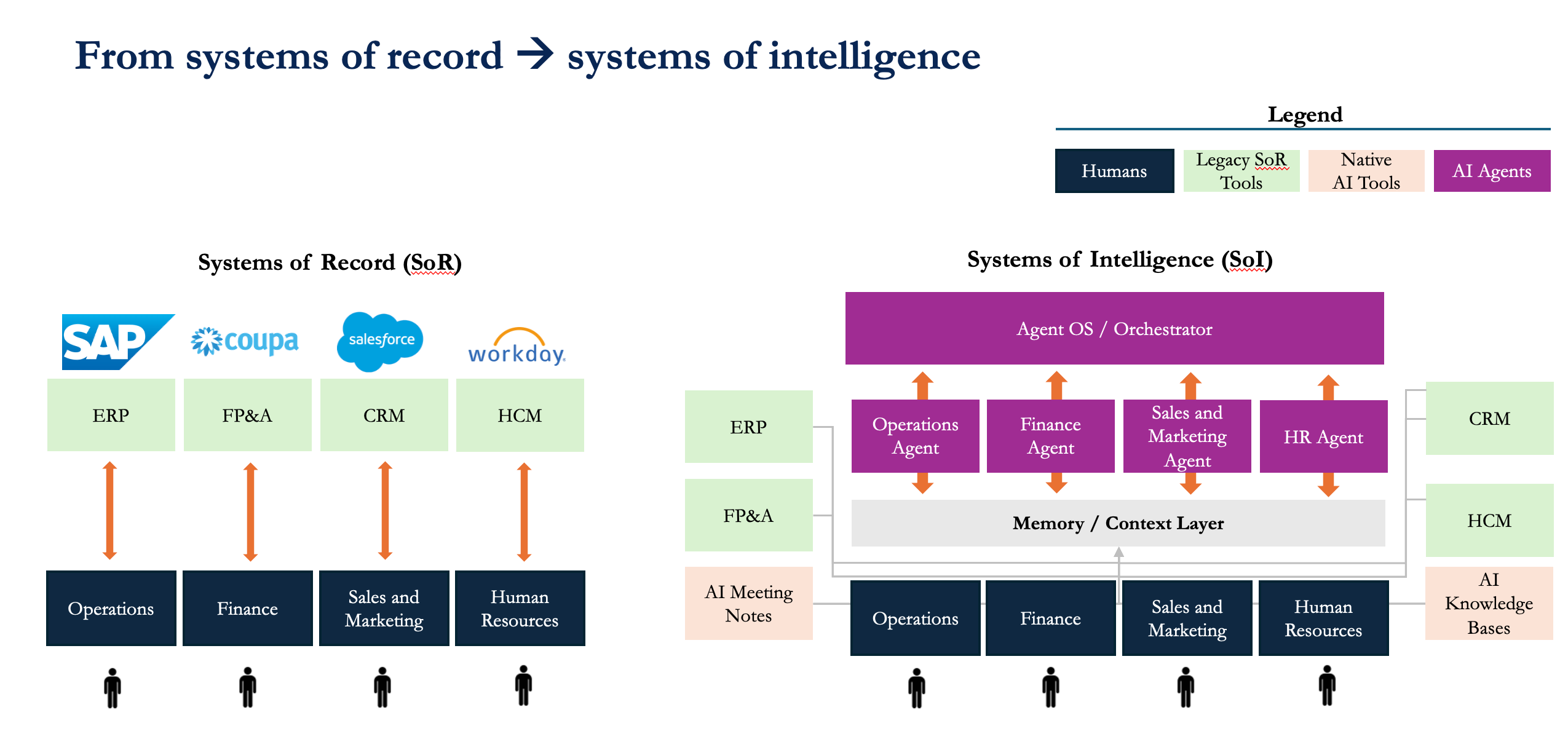
For the past 20 years, enterprise software has been built around Systems of Records.
- CRM stores customer data
- ERP stores operational data
- HCM stores employee data
- Etc. etc.
Each system is valuable but also deeply siloed.
In many ways, these systems are like filing cabinets - incredibly useful for storing information, but fundamentally bounded. It can only answer questions in that filing cabinet
The fundamental unlock with AI is the ability to stitch together data across systems into a unified context and memory layer and allows it to be reasoned over.
This is what I’d call “Systems of Intelligence.”
The difference shows up in the questions you can ask.
A system of record question is:
“Which deals are in the pipeline this quarter?”
-> This requires a lookup query within a single cabinet, usually a CRM system like Salesforce
A system of intelligence question is:
“Which deals are likely to slip, why, and how will it impact our financials”
-> This requires a person to look through multiple cabinets, CRM, customer support, and financial systems
If systems of record are filing cabinets, systems of intelligence are the brain that looks across all of them, makes decisions, and proactively suggests actions.
It’s the difference between an airport control tower making decisions with visibility into one runway vs. across the entire airport. Who would you rather have?
This is why the market is nervous.
The market is repricing who actually owns the intelligence layer inside an organization.
If systems of intelligence become the primary interface, then systems of record get abstracted into the background. Still necessary, but more akin to database companies and no longer where the main value accrues.
Those incumbent systems of record companies that can’t adapt will be replaced by AI-native startups.
But those that can adapt by owning the context layer and embedding intelligence into workflows, will likely emerge even stronger than before.
We’re already seeing good progress from some incumbents. For e.g., Rippling just rolled out GenAI across HR, IT, and finance workflows today. And ServiceNow has embedded GenAI deeply into its platform.
In platform shifts like this, standing still is the fastest way to fall behind.
As Andy Grove once remarked: “only the paranoid survive”
- * *
#### Subscribe to AI Musings by Mu
By Kelvin Mu · Launched 2 years ago
I write interesting things about technology, AI, and startups.
Subscribe
By subscribing, you agree Substack's Terms of Use, and acknowledge its Information Collection Notice and Privacy Policy.
[](https://substack.com/note/p-191496835/restacks?utm_source=substack&utm_content=facepile-restacks)
8
Share
#### Discussion about this post
Comments Restacks

Top Latest Discussions
2024 Backward Pass: The Definitive Guide to AI in 2024
Your ultimate recap of AI for 2024
Dec 3, 2024•Kelvin Mu
30
2
3

AI: Are we in another dot-com bubble?
Jul 23, 2024•Kelvin Mu
25
4
3

>$5m ARR | 5x y/y growth | formed after 2020
May 19, 2025•Kelvin Mu
11
1
3

See all
Ready for more?
Subscribe
© 2026 Kelvin Mu · Privacy ∙ Terms ∙ Collection notice
Start your SubstackGet the app
Substack is the home for great culture