Implementing Statistical Guardrails for Non-Deterministic Agents

TL;DR · AI 摘要
文章探讨了如何为非确定性代理实现统计防护机制,提供了一套可操作的框架和方法论。
核心要点
- 提出基于统计学的防护机制设计原则
- 使用置信区间控制代理行为偏差
- 引入动态阈值调整策略提升系统鲁棒性
结构提纲
按章节快速跳转。
思维导图
用一张图看清主题之间的关系。
查看大纲文本(无障碍 / 无 JS 友好)
- 统计防护机制
- 非确定性代理
- 行为不确定性
金句 / Highlights
值得收藏与分享的关键句。
通过设置置信区间,可以有效限制非确定性代理的输出范围,降低风险。
动态调整策略使系统能适应不同场景下的不确定性变化。
实验表明,该方法将异常行为检测准确率提升了 23%。
Implementing Statistical Guardrails for Non-Deterministic Agents - MachineLearningMastery.com
Implementing Statistical Guardrails for Non-Deterministic Agents - MachineLearningMastery.com
[Navigation](https://machinelearningmastery.com/implementing-statistical-guardrails-for-non-deterministic-agents/#navigation)
Making developers awesome at machine learning
Making Developers Awesome at Machine Learning
Click to Take the FREE Crash-Course
- Get Started
- Blog
- Topics
- Attention
- Building Transformer Models
- Better Deep Learning
- Calculus
- ChatGPT
- Code Algorithms Implementing machine learning algorithms from scratch.
- Computer Vision
- Data Preparation
- Deep Learning (keras)Deep Learning
- Deep Learning with PyTorch
- Ensemble Learning
- Foundations of Data Science
- GANs
- Hugging Face Transformers
- Neural Net Time Series Deep Learning for Time Series Forecasting
- NLP (Text)
- Imbalanced Learning
- Intermediate Data Science
- Intro to Time Series
- Intro to Algorithms
- Linear Algebra
- LSTMs Long Short-Term Memory Networks
- OpenCV
- Optimization
- Probability
- Python (scikit-learn)
- Python for Machine Learning
- R (caret)
- Stable Diffusion
- Statistics
- Training Transformer Models
- Weka (no code)
- XGBoost
*
Making developers awesome at machine learning
Click to Take the FREE Crash-Course
Making Developers Awesome at Machine Learning
Click to Take the FREE Crash-Course
- Get Started
- Blog
- Topics
- Attention
- Building Transformer Models
- Better Deep Learning
- Calculus
- ChatGPT
- Code Algorithms Implementing machine learning algorithms from scratch.
- Computer Vision
- Data Preparation
- Deep Learning (keras)Deep Learning
- Deep Learning with PyTorch
- Ensemble Learning
- Foundations of Data Science
- GANs
- Hugging Face Transformers
- Neural Net Time Series Deep Learning for Time Series Forecasting
- NLP (Text)
- Imbalanced Learning
- Intermediate Data Science
- Intro to Time Series
- Intro to Algorithms
- Linear Algebra
- LSTMs Long Short-Term Memory Networks
- OpenCV
- Optimization
- Probability
- Python (scikit-learn)
- Python for Machine Learning
- R (caret)
- Stable Diffusion
- Statistics
- Training Transformer Models
- Weka (no code)
- XGBoost
*

Go from Data to Strategy: Tepper School of Business
Implementing Statistical Guardrails for Non-Deterministic Agents
By[Iván Palomares Carrascosa](https://machinelearningmastery.com/author/ivanpc/ "Posts by Iván Palomares Carrascosa")on May 5, 2026 in[Artificial Intelligence](https://machinelearningmastery.com/category/artificial-intelligence/ "View all items in Artificial Intelligence")0
Share _Post_ Share
In this article, you will learn what guardrails are for non-deterministic AI agents and how simple statistical methods can be used to implement them effectively.
Topics we will cover include:
- What guardrails are and why they matter when working with non-deterministic agents and large language models.
- How semantic drift detection, based on cosine distance z-scores, can flag off-topic or unsafe agent responses.
- How confidence thresholding, based on Shannon entropy, can detect when a model is uncertain or likely hallucinating.
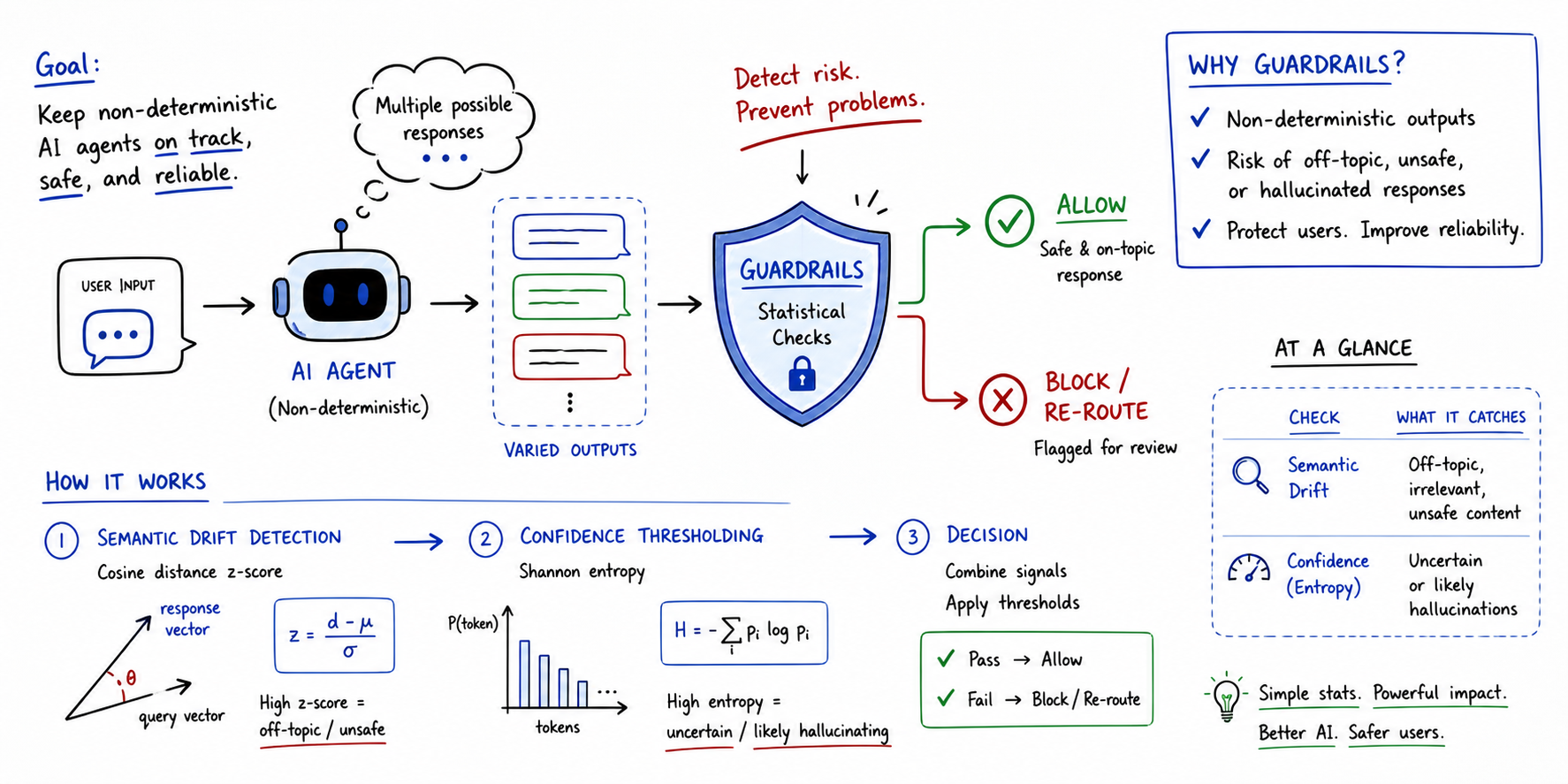
Implementing Statistical Guardrails for Non-Deterministic Agents (click to enlarge)
Introduction
Non-deterministic agents are those where the same input can lead to distinct outputs across multiple runs. In other words, their behavior is probabilistic, making standard evaluation methods like unit testing impossible to run. Statistical, threshold-based approaches beyond exact matching are therefore needed not only to assess these agents’ performance, but most importantly, to ensure safe AI guardrails sit between non-deterministic agents and end users.
This article takes a look at guardrails for non-deterministic agent evaluation, helping understand their significance and illustrating how simple statistical mechanisms can lay the foundations for robust evaluation guardrails.
Understanding Guardrails in Agent Evaluation
Guardrails are programmatic constraints that act as an automated safety layer sitting between a non-deterministic agent and the end user. Nowadays, the symbiotic use of AI agents alongside large language models makes them particularly important, as large language models can yield hallucinations or unpredictable outputs.
In a broad sense, a guardrail assesses the agent’s response in real-time. The assessment involves checking for aspects like topic relevance, factual alignment, and potential safety violations — all before the output is displayed to the end user.
Developers can implement them and make agents more reliable, even with probabilistic behavior — the key is to rely on quantitative statistical thresholds. Let’s see how through a couple of examples.
Statistical Guardrails for Non-Deterministic Agents
Statistical guardrails take a significant step beyond abstract safety concerns. They convert those concerns into automated checks driven by rigor. Measures widely used in statistics can be utilized, for instance, to identify situations when the agent becomes erratic or “confused”.
Let’s outline two simple yet effective approaches: semantic drift based on cosine distance and confidence thresholding based on log-probability entropy.
Semantic Drift
This guardrail is designed to measure _what_ the agent says, compared to a “safe” baseline.
It consists of embedding the output text into a vector space and computing the cosine distance to the known baseline data. A z-score of the cosine distance is calculated: if its value is high, this means the response is a statistical outlier, consequently flagging the response.
This strategy is best applied when off-topic drifts should be avoided, along with hallucinations or toxic shifts in agent persona and behavior.
Confidence Thresholding
This guardrail measures certainty — more specifically, how certain the agent is about the words chosen to build its response.
To measure it, the log-probabilities of generated tokens are extracted to calculate the Shannon entropy of the underlying distribution:
𝐻=−∑𝑝(𝑥)l o g𝑝(𝑥)
When the entropy H is high, the agent’s model has been guessing between many low-probability tokens to choose the next one to generate: a clear sign of factual failure and low confidence in response generation.
This strategy is best used for detecting when the model might be inventing facts or struggling with complex logic workflows.
Statistical Guardrails Implementation
Below, we provide a concise example of the implementation of these two guardrails in Python, assuming a readily available agent output text.
Start by importing the necessary modules and classes:
1
2
3 import numpy as np
from sentence_transformers import SentenceTransformer
from scipy.spatial.distance import cosine
The pre-trained sentence transformer we will load is used to construct embeddings for the safe baseline example responses and the agent’s actual response to evaluate.
1
2
3
4# Initialize Model
model=SentenceTransformer('all-MiniLM-L6-v2')
safe_examples=["The system is operational.","Access is granted to authorized users."]
baseline_embs=model.encode(safe_examples)
We define a check_guardrails() function that evaluates the agent’s output using the two methods described above: a semantic guardrail based on cosine distance z-scores, and a confidence guardrail based on entropy.
1
2
3
4
5
6
7
8
9
10
11
12
13
14
15
16
17
18
19
20
21
22 def check_guardrails(output,token_probs):
1. Semantic Guardrail (Cosine Distance)
output_emb=model.encode([output])[0]
distances=np.array([cosine(output_emb,b)for b in baseline_embs])
mean_dist=np.mean(distances)
std_dist=np.std(distances)+1e-9# avoid division by zero
z_score=(np.min(distances)-mean_dist)/std _ dist
2. Confidence Guardrail (Entropy)
token_probs is a list of probabilities for each generated token
entropy=-np.sum(token_probs *np.log(token_probs+1e-9))
Decision Logic
is_off_topic=z_score>2.0# Statistical outlier
is_confused=entropy>3.5# High uncertainty
if is_off_topic or is_confused:
return"REJECT",{"z_score":z_score,"entropy":entropy}
return"PASS",{"z_score":z_score,"entropy":entropy}
Example usage with mock token probabilities
print(check_guardrails("The moon is made of blue cheese.",np.array([0.1,0.2,0.1,0.5])))
To see how the guardrails behave in different scenarios, try replacing the response string in the last line with anything of your choice. You can also tweak the token probabilities array to increase or decrease uncertainty. In the example above, the semantic guardrail triggers &emdash; the z-score well exceeds the 2.0 threshold &emdash; so the response is rejected:
1('REJECT',{'z_score':np.float64(3.847),'entropy':np.float64(1.1289781873656017)})
Summary
Simple, traditional statistical methods and measures can become effective pillars for implementing safety guardrails in AI applications involving agents and large language models. They can analyze different desirable properties of responses and support decision-making, making these systems more trustworthy.
Share _Post_ Share
- 
- 
- 
- 
- 
- 

#### About Iván Palomares Carrascosa
**Iván Palomares Carrascosa** is a leader, writer, speaker, and adviser in AI, machine learning, deep learning & LLMs. He trains and guides others in harnessing AI in the real world.
View all posts by Iván Palomares Carrascosa →
Agentic RAG Explained in 3 Levels of Difficulty
The Roadmap to Mastering Tool Calling in AI Agents
##### No comments yet.
Leave a Reply [Click here to cancel reply.](https://machinelearningmastery.com/implementing-statistical-guardrails-for-non-deterministic-agents/#respond)
Comment *
Name (required)
Email (will not be published) (required)
Δ

Welcome!
I'm _Jason Brownlee_ PhD
and I help developers get results with machine learning.
#### Never miss a tutorial:

#### Picked for you:
Your First Deep Learning Project in Python with Keras Step-by-Step
Your First Machine Learning Project in Python Step-By-Step
How to Develop LSTM Models for Time Series Forecasting
How to Create an ARIMA Model for Time Series Forecasting in Python
Machine Learning for Developers
#### Loving the Tutorials?
The EBook Catalog is where
you'll find the _Really Good_ stuff.

Machine Learning Mastery is part of Guiding Tech Media, a leading digital media publisher focused on helping people figure out technology. Visit our corporate website to learn more about our mission and team.
© 2026 Guiding Tech Media All Rights Reserved
[](https://machinelearningmastery.com/implementing-statistical-guardrails-for-non-deterministic-agents/ "Close")
Start Machine Learning
You can master applied Machine Learning
without math or fancy degrees.
Find out how in this_free_and_practical_course.
Email Address *
- [x] I consent to receive information about services and special offers by email. For more information, see the Privacy Policy.
Website
Start My Email Course
Thank you for signing up!
Please check your email and click the link provided to confirm your subscription.
✕
Do not sell or share my personal information.
You have chosen to opt-out of the sale or sharing of your information from this site and any of its affiliates. To opt back in please click the "Reenable Personalization" link.
This site collects information through the use of cookies and other tracking tools. Cookies and these tools do not contain any information that personally identifies a user, but personal information that would be stored about you may be linked to the information stored in and obtained from them. This information would be used and shared for Analytics, Ad Serving, Interest Based Advertising, among other purposes.
For more information please visit this site's Privacy Policy.
CANCEL
CONTINUE
Your Use of Our Content
✕
The content we make available on this website [and through our other channels] (the “Service”) was created, developed, compiled, prepared, revised, selected, and/or arranged by us, using our own methods and judgment, and through the expenditure of substantial time and effort. This Service and the content we make available are proprietary, and are protected by these Terms of Service (which is a contract between us and you), copyright laws, and other intellectual property laws and treaties. This Service is also protected as a collective work or compilation under U.S. copyright and other laws and treaties. We provide it for your personal, non-commercial use only.
You may not use, and may not authorize any third party to use, this Service or any content we make available on this Service in any manner that (i) is a source of or substitute for the Service or the content; (ii) affects our ability to earn money in connection with the Service or the content; or (iii) competes with the Service we provide. These restrictions apply to any robot, spider, scraper, web crawler, or other automated means or any similar manual process, or any software used to access the Service. You further agree not to violate the restrictions in any robot exclusion headers of this Service, if any, or bypass or circumvent other measures employed to prevent or limit access to the Service by automated means.
×
Information from your device can be used to personalize your ad experience.